What Is the Bordeaux AOC?
Bordeaux is one of the largest and oldest wine-making regions in France and is an integral part of French viticulture heritage, producing some of the finest wines in the world. Bordeaux vineyards have existed for more than two thousand years. The first vines were brought to the region around 60 BC by the Roman invaders, who moved across France, planting vines along the way. They called Bordeaux Burdigala, and the first vineyards were planted in Graves. The wines started to garner attention in the first century AD, were distributed to the Roman soldiers as well as other citizens in Gaul and Britain.
In 1152, another noteworthy event influenced Bordeaux production: the marriage of Eleanor of Aquitaine to the future king of England, Henry II. For the next three hundred years, the region remained under English control. As a result, Bordeaux exported the majority of its wine production to England.
At the end of the 16th century, the French asked the Dutch, who at the time were the largest importers of French wines, to help them drain various swampy areas across France. The marshes in Bordeaux and Médoc were a top priority. Under the leadership of Conrad Gaussen, they drained the swamps and created dykes alongside the Gironde and giant dunes along the edge of the Atlantic Ocean to protect the newly drained land.
The land was perfect terroir for wine production, extending the region's vineyard surface by fifteen per cent, creating the Médoc region some of the finest vineyards in the world, further helping to cement the region's reputation as a producer of high-quality wines. This activity also facilitated the transport of the wines out of the region.
Over the years, the wines of Bordeaux rose in popularity across Europe, especially England and the Netherlands. They eventually gained a reputation among worldwide wine connoisseurs, such as the American President Thomas Jefferson, who was an avid fine wine collector. The entire vineyard area was called the Vignoble de Bordeaux, and in 1725, the first appellation boundaries were created.
Between 1869 and 1880, Phylloxera decimated up to 60 per cent of all vineyards across Europe, including Bordeaux. This led to a shortage of premium French wines and an increase in wine fraud, where nefarious individuals created fake wines claiming that they came from prestigious wine production areas.
History of the Bordeaux AOC System
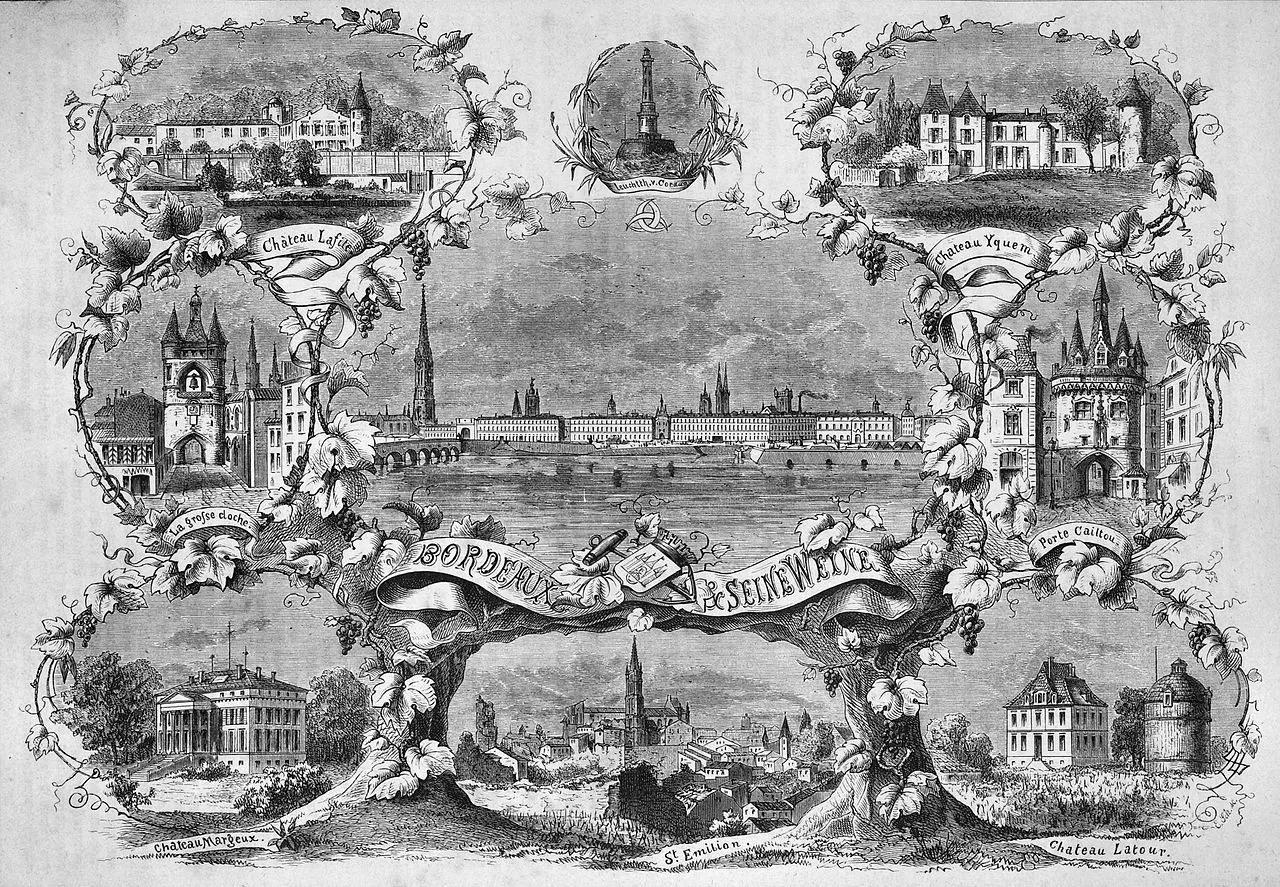
The creation of the AOC system in France began in 1924 in Châteauneuf-du-Pape in the Southern Rhône Valley. The ravages of phylloxera in the late 20th century, along with a decline in the wine quality and increased wine fraud, led Baron Le Roy to create a local winegrowers association. Together with his friend, the former minister of agriculture, Joseph Capus, he created the INAO (French national institute for the designation of origins), which is responsible for granting AOC status to wine regions and wines in 1935.
Applications for AOC French wine classifications were submitted by viticultural regions across France. Bordeaux AOC received its AOC status on 14 November 1936. Bordeaux wine law ensures that regional wine identity and production criteria are met under a strict system that applies to all AOP wines in France. Different laws apply depending on the region where the wines are produced.
Bordeaux AOC (Appellation d’Origine Contrôlée) ensures that every one of the 57 Bordeaux wine appellations produced in the region is identified by its terroir, varied microclimates, and other factors that make each wine unique. Every AOC falls under the main Bordeaux AOC classification. This designation is further divided into different sub-regional Bordeaux appellations. Each one is strictly regulated to conform to local and national French wine AOC rules.
The strict AOC rules applied to each appellation ensure wine authenticity and origin protection, which is key to appellation control in French wine. Each of the fifty-seven appellations in Bordeaux is listed in the thirty-eight separate Cahiers des Charges (the rule books that strictly control the area of wine production and how it is made). Many of the Cahier’s rules are based on the French terroir system as well as vineyard regulations in France.
Bordeaux Wine Labelling Rules
Information required to conform to AOC Rules:
- The word Bordeaux must appear somewhere on the label.
- France is the country of origin where the grapes were grown.
- The name of the appellation, such as Médoc, Margaux, Sauternes, Saint-Émilion, etc, which indicates the protected area of wine production and guarantees that the producer has met appellation requirements.
- The identity of the wine bottler, as well as the date of bottling. AOC wines must be bottled in the production area. This protects the authenticity and quality of the wine and prevents fraudulent activities.
- The alcohol percentage by volume must show the % sign. In the EU, typical labelling is noted to 0.5% so the volume will either end in .5 or .0.
- The amount of wine in the bottle is displayed in centilitres or millilitres (cl or ml). The most common size bottles run from 37.5 cl to 300cl, though there are much larger speciality bottles.
Optional information: The estate name, vintage, awards, grape varieties used in the blend, wine description, viticultural and winemaking method (i.e. organic, biodynamic, sustainable). Though not required, most producers will include this information as it helps further authenticate their wines and is a valuable marketing tool.
Bordeaux AOC is the largest appellation in Bordeaux, with five generic appellations and one geographic Indication. Dry and sweet red, white, rosé, and sparkling wines can be made in any of the fifty-seven regional appellation areas. AOC was granted in 1936.
Bordeaux Wine Types and Rules
Bordeaux Rouge wines account for around sixty per cent of Bordelais wine production. Only Merlot, Cabernet Sauvignon, Cabernet Franc, Malbec, Carménère, and Petit Verdot are permitted, with a maximum yield of fifty-five hectolitres per hectare. To receive AOC status, they must undergo a chemical analysis and an official tasting. Wines are supple, fruity, and discreet.
The same varietals are permitted in the production of Bordeaux Rosé wines, which must also undergo the same AOC status procedure. Wines are typically consumed within one or two years.
Bordeaux Blanc wines must be made with Sauvignon Blanc, Muscadelle, Sémillon, Sauvignon Gris, Colombard, and Ugni Blanc. Sweet versions with Muscadelle, Sauvignon Blanc, and Sémillon.
Bordeaux Supérieur Rouge can produce wines using the same grape varietals as Bordeaux Rouge. The difference between Bordeaux AOC and Bordeaux Supérieur is that the rules of production for Supérieur wines are much stricter. Permitted yield per hectare is more stringent (50 hectolitres), and higher alcohol levels (0.5%). Wines must be aged for a minimum of twelve months in oak before bottling and sale. It received its AOC status in 1943.
Bordeaux Supérieur Blanc produces sweet wines in limited quantities from Merlot Blanc, Ugni Blanc, Sauvignon Blanc, Muscadelle, and Sémillon. Production is extremely limited. Wines that are light, refreshing, fruity, and slightly sweet.
Crémant de Bordeaux received its AOC certification in 1990. White and rosé versions are made using the méthode traditionelle, the same process that is used in Champagne. White Crémant is made from Ugni Blanc, Colombard, Muscadelle, Sauvignon Blanc, and Sémillon. Rosé Crémant is made using Cabernet Franc, Merlot, and Malbec. Wines display fine bubbles, are dry, and complex with a long finish.
Bordeaux Clairet (the name that the English used for Bordeaux wines in the Middle Ages) are made from Merlot. These wines have a ruby colour, low tannins, are light, silky, fresh, and easy to drink. The wines must undergo the same stringent rules as other Bordeaux AOC wines to achieve their AOC status.
Fine Bordeaux is a geographical indication created in 2014. It is a white spirit distilled strictly from white wines vinified in the AOC Bordeaux region.
Bordeaux Wine Regions Explained
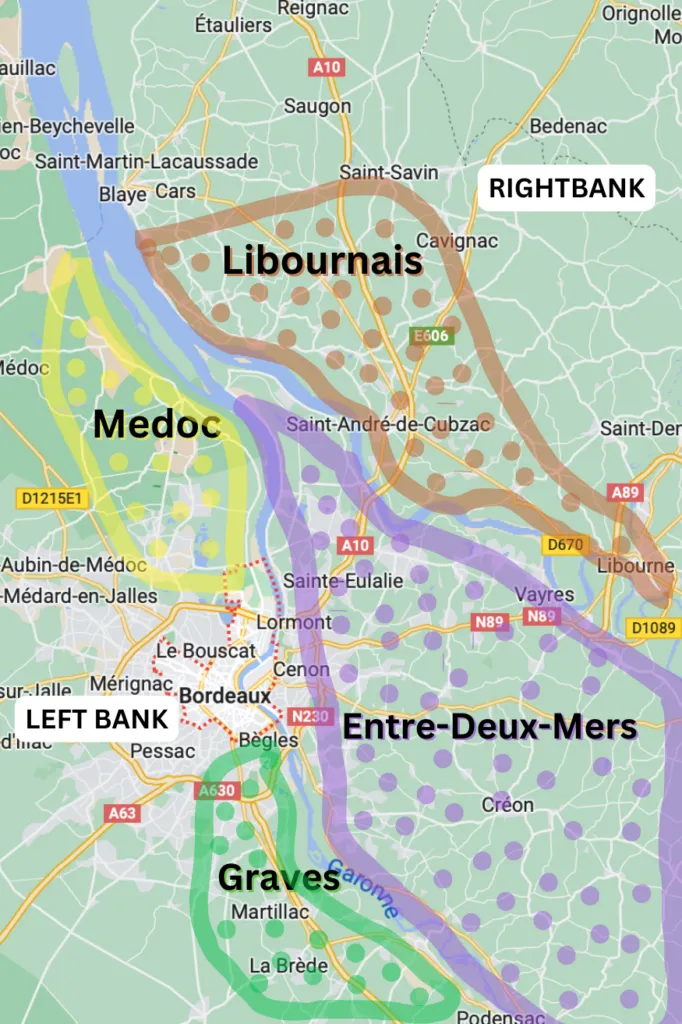
There are over 111,000 hectares of vineyards in Bordeaux, making it one of the largest and most famous wine-producing regions in France. Bordeaux is home to over seven thousand different Châteaux and produces more than ten million different wines every year. The Bordeaux appellation map covers Bordeaux’s Left Bank and Right Bank, and Entre-Deux-Mers. There are many sub-regions within the three main areas. Learning how the Bordeaux AOC system works is key to understanding Bordeaux wine appellations.
Left Bank
The Left Bank is in the south of the Bordeaux wine region, close to the city of Bordeaux.
Médoc AOC
This region only produces red wines. Nestled on the 45th parallel, the Left Bank is home to both expansive estates and smaller wineries. It sits between the Atlantic Ocean to the west and the Gironde Estuary to the east. Cabernet Sauvignon is the dominant grape varietal used in most of the wine blends and is key in creating wines that can age for extended periods of time.
- Médoc
- Haut-Médoc
- Margaux
- Moulis
- Listrac-Médoc
- Saint-Julien
- Pauillac
- Saint-Estèphe
Graves AOC
This region produces dry red and white wines as well as sweet white wines. The area is flanked on one side by the Médoc region and on the other by the Gironde Estuary.
- Pessac-Léognan
- Graves
- Graves Supérieure
- Sauternais
- Sauternes
- Barsac
- Cérons
Right Bank
Blaye and Bourg
The region produces dry red and white wines; it is located to the right of the Dordogne River and Gironde Estuary.
- Blaye
- Côtes de Blaye
- Blaye - Côtes de Bordeaux
- Côtes de Bourg
- Côtes de Bordeaux
Libournais
Most of the wine production is red, and the dominant grape varietal used is Merlot. The Dordogne River borders the west of the region.
- Pomerol
- Lalande-de-Pomerol
- Saint-Émilion AOC
- Saint-Émilion Grand Cru
- Fronsac
- Canon Fronsac
- Castillon Côtes de Bordeaux
- Francs Côtes de Bordeaux (only white wine)
- Lussac-Saint-Émilion
- Montagne-Saint-Émilion
- Saint-Georges-Saint-Émilion
- Puissguin-Saint-Émilion
Entre-Deux-Mers AOC
Bordeaux's biggest wine-producing area lies between the Dordogne and Garonne Rivers, where dry white, rosé, red wines, sweet whites, clairet, and crémant are all produced.
- Entre-deux-Mers
- Graves de Vayres
- Sainte-Foy Bordeaux
- Entre-Deux-Mers Haut-Benauge
- Bordeaux Haut-Benauge
- Cadillac Côtes de Bordeaux
- Premières Côtes de Bordeaux
- Côtes de Bordeaux
- Cadillac
- Loupiac
- Côtes de Bordeaux-Saint-Macaire
- Sainte-Croix-du-Mont
Grape Varieties Allowed Bordeaux AOC
There are thirteen grape varietals currently permitted for use in Bordeaux AOC wines. The varietals selected depend on both the kind of wine being produced and the region of origin.
Dry Reds, Rosé, and Clairet
Primary varietals: Merlot, Cabernet Sauvignon, Cabernet Franc
Secondary varietals: Carménère, Malbec, Petit Verdot
Whites: Dry, Sweet, Crémant, and Fine Bordeaux
Primary varietals: Sémillon, Sauvignon Blanc, Muscadelle
Secondary varietals: Colombard, Merlot Blanc, Sauvignon Gris, Ugni Blanc
Bordeaux Wine Classification Guide
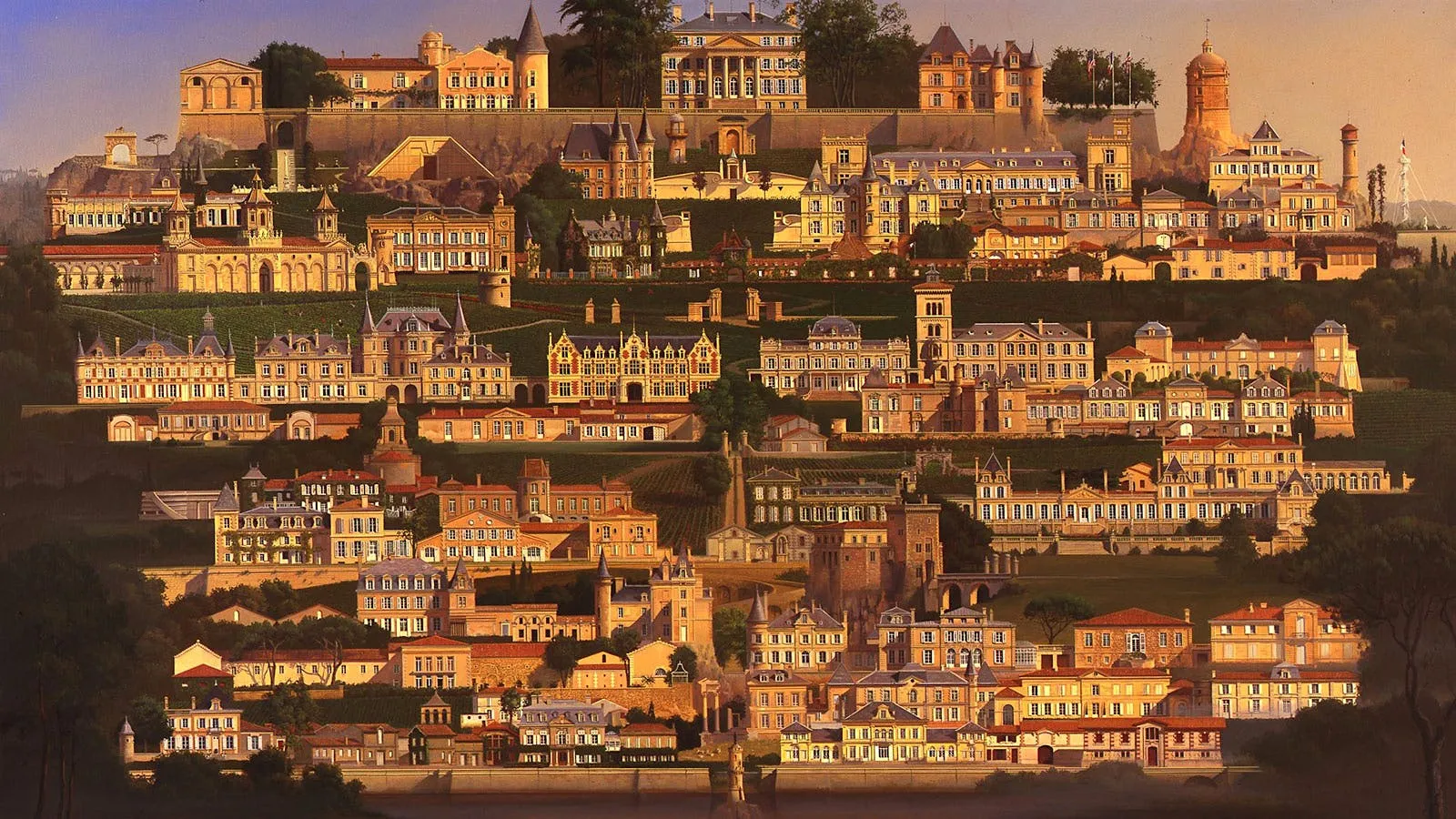
In addition to the lengthy list of AOCs, there are five different wine classifications in Bordeaux; these classifications have nothing to do with appellations but rather the quality of the Châteaux that produce them. These classifications play a particularly significant role when evaluating the quality of the wines produced across the Bordeaux AOC regions.
The 1855 Classification
The 1855 classification was a major turning point in the Bordeaux wine industry. Napoleon III asked the Bordeaux Chamber of Commerce and Industry to classify the Left Bank wineries according to each winery's reputation and the prices their wines commanded. The classification system is based on the Château and not the wine produced; therefore, the properties, not the wines, received the classifications.
Napoleon then requested that the finest wines from the Médoc be sent to Paris, where they were displayed at the Exposition Universelle that he hosted. This resulted in the 1855 Classification of Bordeaux. Bordeaux's classification system is static, and, aside from Château Mouton Rothschild's elevation to Premier Grand Cru in 1973, the original ranking has remained the same.
There are five tiers in the ranking system. For the red wines, there are Premier Grand Crus (5), Deuxième Crus (14), Troisième Cru (14), Quatrième Cru (10), and Cinquième Cru (18). All of them come from Médoc except Premier Cru Château Haut-Brion in Pessac. The white wines are all sweet and are produced in Sauternes and Barsac. There are twenty-six châteaux on the list with one Premier Cru Supérieur, 11 Premier Crus, and 14 deuxième crus.
The Graves Classification 1953
There are sixteen different crus in this classification; the wines are classified by their municipality and the wine colour (red or white). This system has no hierarchy, and the list is never revised.
Saint-Émilion Wine Classification 1955
In 1954, INAO (Institut National des Appellations d’Origine) received a request from the Syndicat de Défense de l'Appellation Saint-Émilion to classify their wines. Classification status was granted in 1955 to eighty-two properties. There are four quality tiers:
- Premier Grand Cru Classé
- Grand Cru Classé
- Premier Grand Cru Classé A
- Premier Grand Cru Classé B
Château Classifications must be reviewed every ten years; the most recent re-classification was released on 8 September 2022. This process of regular reclassification of the properties is an innovative method that ensures that estates continue to progress and creates a healthy competition among them.
Crus Bourgeois du Médoc 1932
Used since the Middle Ages, bourgeois citizens who acquired the best lands in the region and earned this designation. Bordeaux Wine merchants, together with the Bordeaux Chamber of Commerce and the Gironde Chamber of Agriculture, put together a list in 1932. The properties must be in one of the eight appellations (Médoc, Haut-Médoc, Margaux, Moulis-en-Médoc, Listrac-Médoc, Saint-Julien, Pauillac, or Saint-Estèphe) in the Médoc viticultural area. Since 2010, these wines have been given distinct labels, and every September, an official list is released featuring between 240 and 260 estates.
Crus Artisans 1989
For the past 150 years, the term “Cru Artisan” has been an official name for the small wineries belonging to blacksmiths, barrel makers, wheelwrights, and other craftsmen. The Syndicat des Crus Artisan du Médoc came into existence in 1989. As with the Crus Bourgeois, the wineries must be located in one of the eight appellation areas in the Médoc, they must be autonomous operations that produce quality wines with a manager who is actively involved in the operations of his or her vineyard, which produces AOC wines and is bottled at the property. In 1994, the designation was officially reintroduced, and the European Union authorised the mention of “Cru Artisan” on the label. A review of the 36 estates takes place every five years.
Bordeaux Wine Labelling Rules
All Bordeaux AOC wines must conform to specific labelling requirements designed to protect authenticity and ensure transparency for consumers. These rules are enforced under French and EU wine laws.
Mandatory Information
- Bordeaux – The word “Bordeaux” must appear somewhere on the label to identify the region of origin.
- Country of origin – “France” must appear on the label to confirm that the grapes were grown within French territory.
- Appellation name – For example, Médoc, Margaux, Sauternes, or Saint-Émilion. This identifies the protected area of production and certifies that the producer has met all AOC requirements.
- Bottler identity and date – AOC wines must be bottled within the production area to protect authenticity and prevent fraud.
- Alcohol by volume – The percentage must include the “%” sign and is typically shown to the nearest 0.5%.
- Volume – Displayed in centilitres (cl) or millilitres (ml). Common sizes range from 37.5cl to 300cl, although larger bottles also exist.
Optional Information
- Estate name
- Vintage
- Awards or medals
- Grape varieties used in the blend
- Wine description and tasting notes
- Viticultural or winemaking method (e.g., organic, biodynamic, sustainable)
While not compulsory, most Bordeaux producers include these details as they enhance credibility and marketability.
Bordeaux AOC Classifications
The Bordeaux AOC is the largest appellation in the region, encompassing five generic appellations and one geographical indication. Wines may be red, white, rosé, sweet, or sparkling, and production can occur anywhere within the 57 regional appellation areas. The Bordeaux AOC was officially granted in 1936.
Bordeaux Rouge wines account for around 60% of total Bordelais production. Only Merlot, Cabernet Sauvignon, Cabernet Franc, Malbec, Carménère, and Petit Verdot are authorised. Maximum yields are limited to 55 hectolitres per hectare. To earn AOC status, wines must undergo chemical analysis and official tasting. These wines are typically supple, fruity, and elegant.
Bordeaux Rosé wines use the same varietals and must also pass the same AOC inspection process. They are usually light, fresh, and best consumed within one or two years.
Bordeaux Blanc wines are made from Sauvignon Blanc, Muscadelle, Sémillon, Sauvignon Gris, Colombard, and Ugni Blanc. Sweet white Bordeaux wines are typically blends of Muscadelle, Sauvignon Blanc, and Sémillon.
Bordeaux Supérieur Rouge follows stricter production rules than standard Bordeaux Rouge. Yields are capped at 50 hectolitres per hectare, and wines must reach 0.5% higher alcohol levels. They must also be aged for at least 12 months in oak before bottling and sale. Bordeaux Supérieur Rouge received AOC status in 1943.
Bordeaux Supérieur Blanc produces small quantities of sweet white wines from Merlot Blanc, Ugni Blanc, Sauvignon Blanc, Muscadelle, and Sémillon. These wines are light, fruity, and slightly sweet.
Crémant de Bordeaux received its AOC certification in 1990. Both white and rosé versions are produced using the méthode traditionnelle, the same process as Champagne. White Crémant is made from Ugni Blanc, Colombard, Muscadelle, Sauvignon Blanc, and Sémillon, while Rosé Crémant uses Cabernet Franc, Merlot, and Malbec. These wines are dry, elegant, and complex, with fine bubbles and a long finish.
Bordeaux Clairet—the name the English once used for Bordeaux wines in the Middle Ages—is made primarily from Merlot. The wines are ruby-coloured, light, and silky, with low tannins and a fresh, approachable character. Clairet wines must comply with the same stringent AOC regulations as other Bordeaux wines.
Fine Bordeaux is a geographical indication created in 2014 for white spirits distilled exclusively from white wines vinified within the Bordeaux AOC region.
Bordeaux AOC Wine Regions Explained
With over 111,000 hectares of vineyards, Bordeaux is one of France’s largest and most famous wine-producing regions. It is home to more than 7,000 Châteaux, producing over ten million bottles of wine annually. The Bordeaux appellation map covers three main areas: the Left Bank, the Right Bank, and Entre-Deux-Mers. Understanding these regions is essential to comprehending how the Bordeaux AOC system functions.
Left Bank
Located south of the city of Bordeaux, the Left Bank is bordered by the Atlantic Ocean to the west and the Gironde Estuary to the east. It is best known for red wines dominated by Cabernet Sauvignon, renowned for their longevity and structure.
Médoc AOC
This region produces exclusively red wines. It includes:
- Médoc
- Haut-Médoc
- Margaux
- Moulis
- Listrac-Médoc
- Saint-Julien
- Pauillac
- Saint-Estèphe
Graves AOC
Producing dry red and white wines, as well as sweet whites, Graves sits between Médoc and the Gironde Estuary. Key appellations include:
- Pessac-Léognan
- Graves
- Graves Supérieure
Sauternais
This sub-region produces only sweet white wines and is surrounded by the Médoc appellation. Major areas include:
- Sauternes
- Barsac
- Cérons
Right Bank
Blaye and Bourg
Situated east of the Gironde Estuary and the Dordogne River, this region produces both dry red and white wines. Its key appellations include:
- Blaye
- Côtes de Blaye
- Blaye – Côtes de Bordeaux
- Côtes de Bourg
- Côtes de Bordeaux
Libournais
Known primarily for red wines, the dominant grape here is Merlot. The Dordogne River borders it to the west. Important appellations include:
- Pomerol
- Lalande-de-Pomerol
- Saint-Émilion AOC
- Saint-Émilion Grand Cru
- Fronsac
- Canon Fronsac
- Castillon Côtes de Bordeaux
- Francs Côtes de Bordeaux (the only one in the area producing white wines)
- Lussac-Saint-Émilion
- Montagne-Saint-Émilion
- Saint-Georges-Saint-Émilion
- Puissguin-Saint-Émilion
Entre-Deux-Mers AOC
The largest wine-producing area of Bordeaux lies between the Dordogne and Garonne rivers. It produces dry white, rosé, red, sweet white, clairet, and crémant wines. Key appellations include:
- Entre-Deux-Mers
- Graves de Vayres
- Sainte-Foy Bordeaux
- Entre-Deux-Mers Haut-Benauge
- Bordeaux Haut-Benauge
- Cadillac Côtes de Bordeaux
- Premières Côtes de Bordeaux
- Côtes de Bordeaux
- Cadillac
- Loupiac
- Côtes de Bordeaux-Saint-Macaire
- Sainte-Croix-du-Mont
Grape Varieties Permitted in Bordeaux AOC Wines
There are thirteen authorised grape varieties in the Bordeaux AOC. The varietals used depend on the wine style and region of origin.
Dry Reds, Rosé, and Clairet
- Primary varietals: Merlot, Cabernet Sauvignon, Cabernet Franc
- Secondary varietals: Carménère, Malbec, Petit Verdot
Whites: Dry, Sweet, Crémant, and Fine Bordeaux
- Primary varietals: Sémillon, Sauvignon Blanc, Muscadelle
- Secondary varietals: Colombard, Merlot Blanc, Sauvignon Gris, Ugni Blanc
Bordeaux Wine Classification Guide
In addition to the 57 Bordeaux AOCs, there are five distinct wine classification systems based on estate quality rather than geographical appellation. These systems help evaluate the prestige of wines within the Bordeaux region.
The 1855 Classification
Commissioned by Napoleon III, the 1855 Classification ranked the top châteaux of the Left Bank according to reputation and market price. The resulting hierarchy was displayed at the Exposition Universelle in Paris, solidifying Bordeaux’s global reputation.
The classification remains largely unchanged except for Château Mouton Rothschild, which was elevated to Premier Grand Cru in 1973. There are five tiers for red wines: Premier (5), Deuxième (14), Troisième (14), Quatrième (10), and Cinquième (18) crus. All are from Médoc, except Château Haut-Brion in Pessac. The white wines—produced in Sauternes and Barsac—include 26 estates: one Premier Cru Supérieur, eleven Premier Crus, and fourteen Deuxième Crus.
The Graves Classification (1953)
This classification covers sixteen crus, divided by municipality and wine colour (red or white). It has no hierarchy and remains unchanged over time.
Saint-Émilion Wine Classification (1955)
Created by the INAO at the request of the Syndicat de Défense de l'Appellation Saint-Émilion, the first classification in 1955 recognised 82 estates. It includes four categories: Premier Grand Cru Classé, Grand Cru Classé, Premier Grand Cru Classé A, and Premier Grand Cru Classé B. Unlike other Bordeaux classifications, this one is reviewed every ten years, encouraging continual quality improvement. The latest reclassification was published on 8 September 2022.
Crus Bourgeois du Médoc (1932)
This label dates back to the Middle Ages when bourgeois landowners cultivated some of the Médoc’s finest vineyards. In 1932, the Bordeaux Chamber of Commerce and the Chamber of Agriculture created an official list of eligible estates. To qualify, a property must be located within one of eight Médoc appellations: Médoc, Haut-Médoc, Margaux, Moulis-en-Médoc, Listrac-Médoc, Saint-Julien, Pauillac, or Saint-Estèphe. Each September, an updated list of 240–260 estates is released, and certified wines bear the official “Crus Bourgeois” label.
Crus Artisans (1989)
For more than 150 years, the term “Cru Artisan” has referred to small, independent wineries owned by craftsmen such as blacksmiths, coopers, and wheelwrights. The Syndicat des Crus Artisans du Médoc was officially established in 1989. To qualify, estates must be autonomous, family-run, located within one of the eight Médoc appellations, produce AOC wines, and bottle on-site. In 1994, the European Union authorised the use of “Cru Artisan” on labels. Reviews of the 36 approved estates occur every five years to maintain quality and integrity.
