Cycling Through Bordeaux Vineyards: Understanding Wine at a Slower Pace
There is a pace at which Bordeaux begins to make sense.
Too fast, and it feels fragmented — a series of château names, appellations, and wines that seem connected but never quite align. Slow down, and those connections begin to reveal themselves.
This is a region built on detail.
In the Bordeaux wine region, differences in soil, elevation, and exposure happen within remarkably short distances. A few hundred metres can mean a completely different structure in the glass. But those differences are easy to miss when movement is too quick.
Cycling changes that.
It slows the experience just enough to make the landscape readable.
To understand how Bordeaux is structured — how vineyards relate to one another — it helps to begin with a broader perspective. If you’ve explored The Bordeaux Wine Regions Explained: How the Region Really Works , you’ll already know that Bordeaux is divided by rivers, terroirs, and distinct identities.
But those divisions are not theoretical.
They exist physically — and cycling is one of the most effective ways to see them.
Exploring vineyard landscapes this way, and then connecting those observations through a structured Saint Emilion Wine Tour, allows you to move from simply seeing vineyards to actually understanding them.
Why Cycling Changes the Way You See Wine
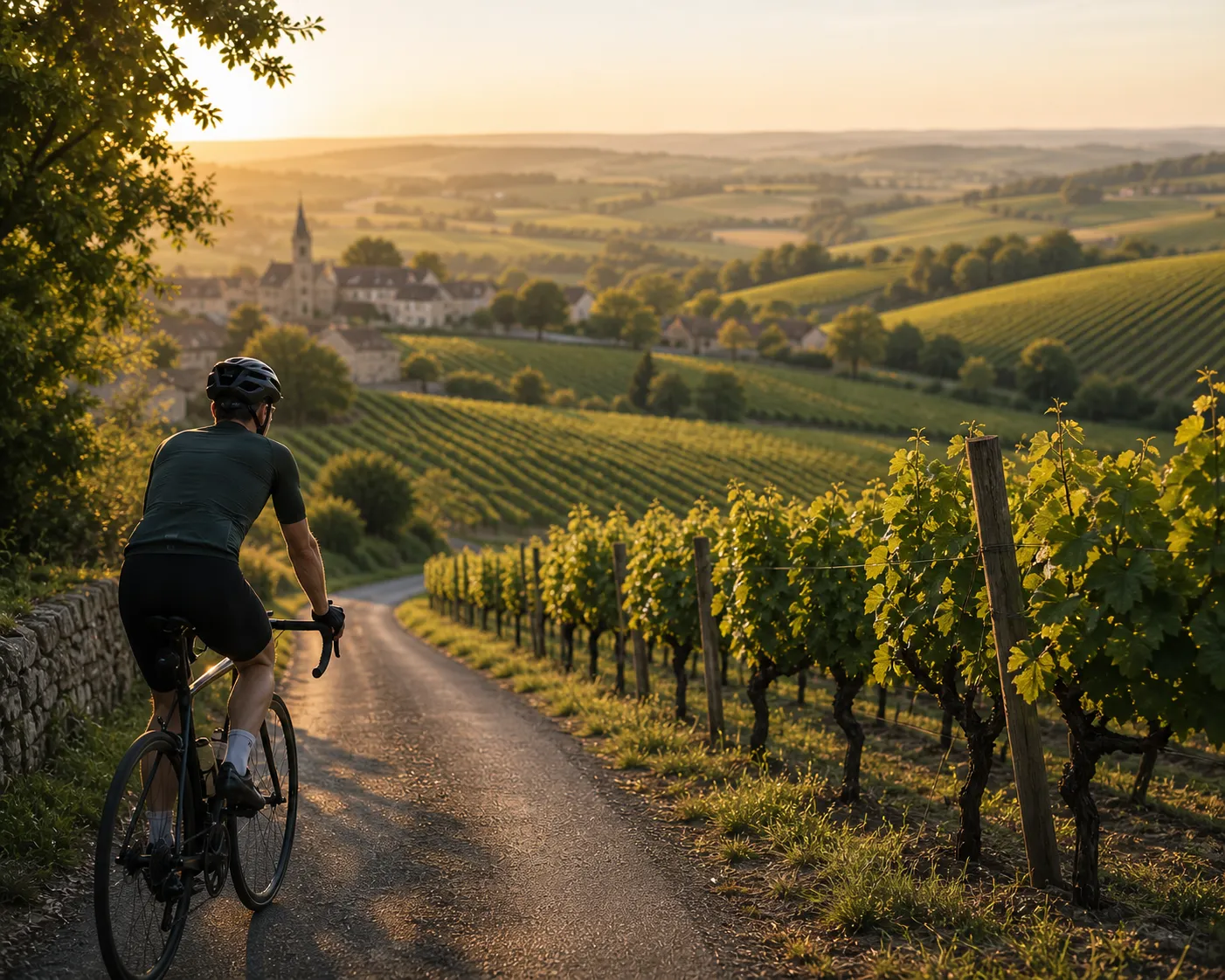
Cycling is not just slower transport — it reshapes how you observe.
At this pace, you begin to notice:
- where slopes begin and end
- how soil colour shifts across parcels
- how vine density changes
- how sunlight exposure varies within minutes
These are not minor details.
They are the foundation of how wine is structured in Bordeaux.
This is a region defined by subtle variation — not dramatic contrast. Cycling gives those subtleties enough time to become visible.
The Landscape Becomes Legible
Ride through Saint-Émilion, and the idea of a uniform vineyard disappears quickly.
Instead, you move through layers:
- limestone plateau at higher elevation
- slopes that influence drainage and ripening
- lower clay-heavy areas that retain moisture
Each transition is gradual, but meaningful.
And each one corresponds to a shift in wine style.
This is where terroir stops being a concept and becomes something you can actually read in the landscape.
Distance Becomes Structure
One of the most important things cycling reveals is how little distance is needed to create difference.
A short ride can take you from:
- structured, tension-driven vineyards
- to softer, more approachable zones
These transitions are too subtle to notice from a car and too abstract to understand from a map.
But on a bicycle, they become clear.
You begin to understand that Bordeaux is not defined by large separations, but by small, precise variations.
The Physical Experience of Terroir
Terroir is often explained intellectually.
Cycling allows you to experience it physically.
You feel:
- the effort of climbing a slope
- the openness of exposed vineyard sections
- the shift in air and temperature between elevations
These sensations connect directly to how vines behave — and ultimately, how wines are structured.
At this point, terroir is no longer theoretical.
It becomes intuitive.
Access Beyond the Obvious
Much of Bordeaux’s most interesting vineyard terrain lies away from main roads.
Cycling allows access to:
- smaller vineyard paths
- less visible parcels
- transitions between estates
This changes your understanding.
Instead of seeing Bordeaux as a collection of individual châteaux, you begin to see it as a continuous landscape shaped by soil and elevation.
Starting Properly: Bike Rental in Saint-Émilion
To explore Bordeaux in this way, where you begin matters.
That’s where Bike Rental Saint Emilion becomes part of the experience rather than just a practical detail.
The shop is based directly in Saint-Émilion itself, meaning you are already inside the vineyard landscape from the moment you start. There is no transition from town to countryside — you step onto the bike and immediately move into one of the most complex vineyard environments in Bordeaux.
What makes this setup particularly effective is that it is designed specifically for vineyard exploration.
The bikes are:
- premium electric bikes
- adapted for vineyard terrain and elevation
- accessible even for those without cycling experience
This matters because Saint-Émilion is not flat. The terrain includes slopes, gravel paths, and uneven vineyard roads. Having equipment suited to this environment makes a significant difference over time.
The shop also provides:
- self-guided vineyard routes
- practical local recommendations
- flexible rental durations without rigid schedules
This flexibility is key.
You are not following a fixed route. You can stop when the soil changes, pause when elevation shifts, and spend time where the landscape becomes interesting.
Even small touches — such as the inclusion of a glass of wine with a full-day rental — reinforce the idea that this is not simply transport, but part of the wine experience itself.
More importantly, it allows you to explore Bordeaux the way it is meant to be understood: gradually, and with attention.
From Observation to Understanding
At a certain point, repeated observation becomes recognition.
You begin to notice patterns:
- higher elevation often leads to more structured wines
- clay-rich areas tend to produce softer textures
- slopes improve drainage and balance
These patterns are not rules, but they form a framework.
And once that framework is in place, tasting changes.
You are no longer just reacting to flavour.
You are recognising structure.
Completing the Experience
Independent exploration builds awareness.
But awareness becomes understanding when it is connected to explanation.
Moving through vineyards at your own pace, then linking those observations to how wines are actually produced and blended, completes the picture. This is where a structured Saint Emilion Wine Tour adds depth — not by replacing exploration, but by giving meaning to what you have already seen.
A Closing Reflection
Cycling through Bordeaux vineyards is not about efficiency.
It is about clarity.
It slows the experience down just enough to reveal the details that define wine — soil, slope, exposure, and connection.
In Bordeaux, understanding wine is not only about tasting.
It is about moving through the landscape that creates it.
And at the right pace, that landscape begins to explain everything.
