Pessac-Léognan Explained: Bordeaux’s Most Versatile Appellation
A Bordeaux Appellation That Refuses Simplicity
There are Bordeaux appellations that announce themselves immediately. Médoc speaks of structure and longevity. Saint-Émilion signals plushness and limestone elegance. Pessac-Léognan, by contrast, does not offer an easy summary. It resists reduction. And that resistance is precisely what makes it so important.
Pessac-Léognan is Bordeaux’s most versatile appellation, not because it tries to be everything, but because it naturally can be. It produces some of the region’s greatest red wines and its most serious dry white wines. It balances power with restraint, tradition with experimentation, and rural viticulture with urban proximity. It is neither an exception nor an anomaly — it is a key to understanding Bordeaux as a whole.
To grasp Pessac-Léognan properly, you must let go of the idea that Bordeaux is neatly divided into Left Bank and Right Bank identities. This appellation sits on the Left Bank geographically, but intellectually it stands slightly apart, shaped by conditions that encouraged early innovation and stylistic freedom.
Why Pessac-Léognan Exists as Its Own Appellation
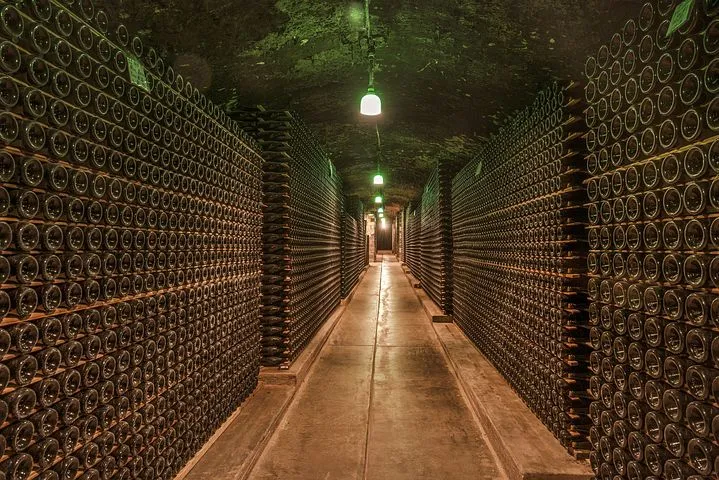
Although Pessac-Léognan forms the northern heart of Graves, it was granted its own appellation status in 1987 — a relatively recent moment in Bordeaux history. That separation was not driven by ambition or marketing, but by recognition.
The wines produced here had long demonstrated a consistency of quality and a stylistic coherence that justified distinction. They were recognisably Graves in origin, yet more precise, more structured, and more age-worthy than many surrounding wines. Over time, the gap became impossible to ignore.
This formal recognition mattered. It acknowledged that terroir, not reputation, defines an appellation’s legitimacy in Bordeaux.
Geography on the Edge of the City — and Why That Matters
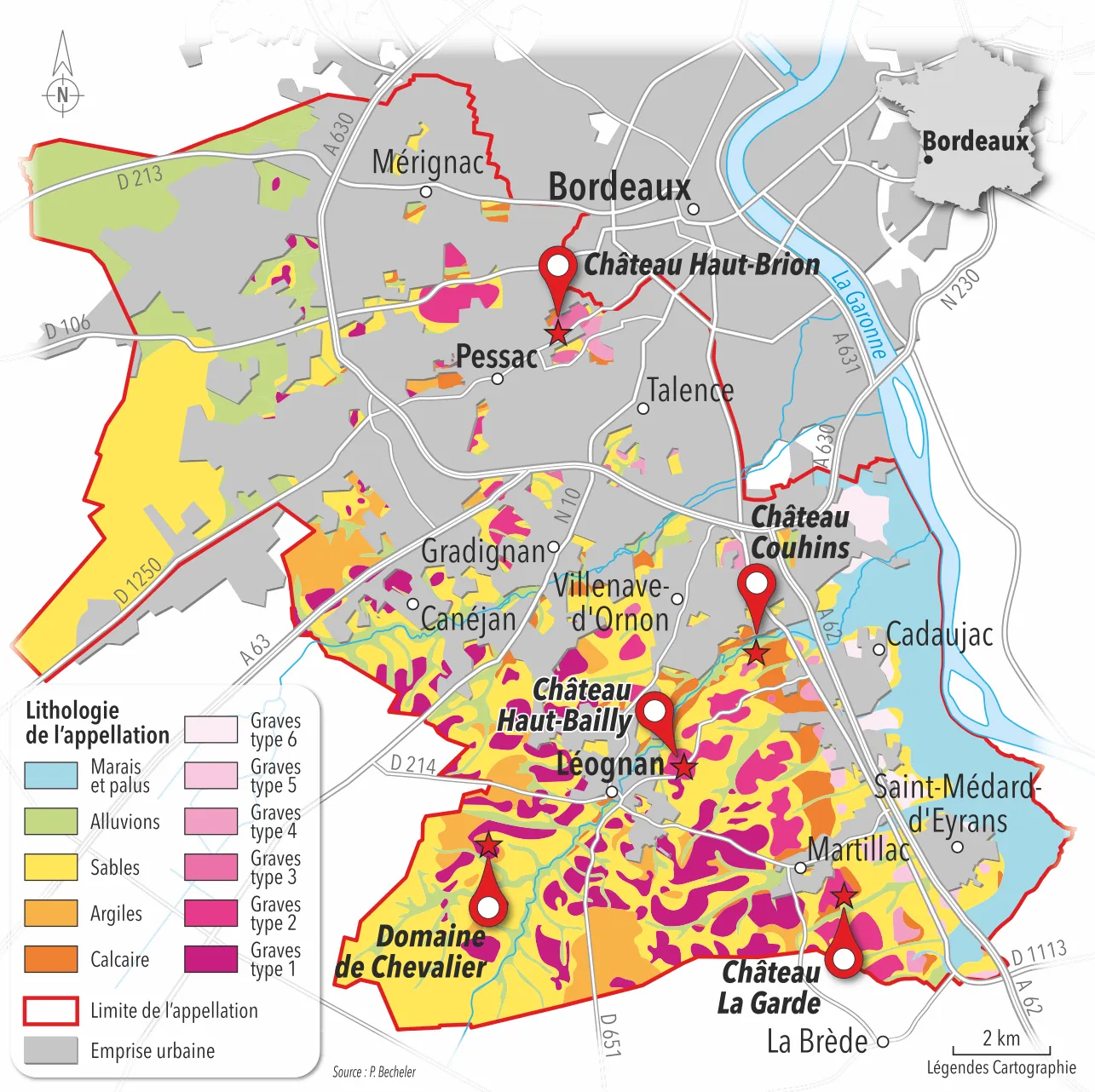
Pessac-Léognan lies immediately south and west of the city of Bordeaux itself. Some vineyards sit astonishingly close to suburban streets, ring roads, and tram lines. This closeness to the city has shaped the appellation in ways that are often overlooked.
Historically, estates here had faster access to merchants, shipping routes, and intellectual exchange. This encouraged experimentation: earlier adoption of estate bottling, refined barrel ageing practices, and a willingness to question tradition when it no longer served quality.
Rather than isolating the vineyards, proximity to the city sharpened them.
Gravel, But Not Just Gravel
Like much of the Left Bank, Pessac-Léognan is defined by gravel. But the gravel here is layered, varied, and underpinned by a complex mix of clay, sand, and limestone. These soils drain freely, preventing waterlogging, while retaining enough moisture to sustain vines during dry summers.
This balance has become increasingly valuable as Bordeaux’s climate has warmed. The soils moderate excess heat, slow sugar accumulation, and allow grapes to reach phenolic ripeness without losing acidity. This geological advantage underpins the appellation’s ability to produce both powerful reds and precise whites under modern conditions.
Gravel here is not just a drainage mechanism — it is a temperature regulator and structural foundation.
Red Wines of Pessac-Léognan: Structure Without Brutality
Red Pessac-Léognan wines are typically built around Cabernet Sauvignon, supported by Merlot and small amounts of Cabernet Franc or Petit Verdot. Structurally, they belong to the Left Bank. Stylistically, they often feel more controlled than their Médoc counterparts.
Rather than emphasising density or scale, these wines prioritise line, freshness, and mineral tension. Tannins are firm but refined. Fruit expression tends toward blackcurrant, dark cherry, and plum rather than sweetness. Alcohol is rarely the dominant force.
One of the defining sensory markers is a smoky, flinty, almost ashy note that appears across many estates. This character is not driven by oak. It is a soil expression — a mineral signature that gives the wines seriousness and identity.
You can experience this clarity of style at estates such as Château Haut-Brion, whose reds combine authority with restraint, and Château La Mission Haut-Brion, where structure and depth are shaped with remarkable precision.
Oak in Pessac-Léognan: Architecture, Not Cosmetics
Oak plays a crucial role in Pessac-Léognan, but it is never decorative. The appellation was among the first in Bordeaux to understand oak as a structural instrument rather than a flavouring tool.
Barrels here are used to stabilise wines, refine tannins, and allow slow, controlled evolution. New oak is employed carefully, often in varying proportions depending on vintage conditions and grape composition. Integration over time is prioritised above immediate impact.
This philosophy explains why Pessac-Léognan wines often show visible oak in youth but remarkable harmony with age.
Whites That Redefine Bordeaux’s Potential
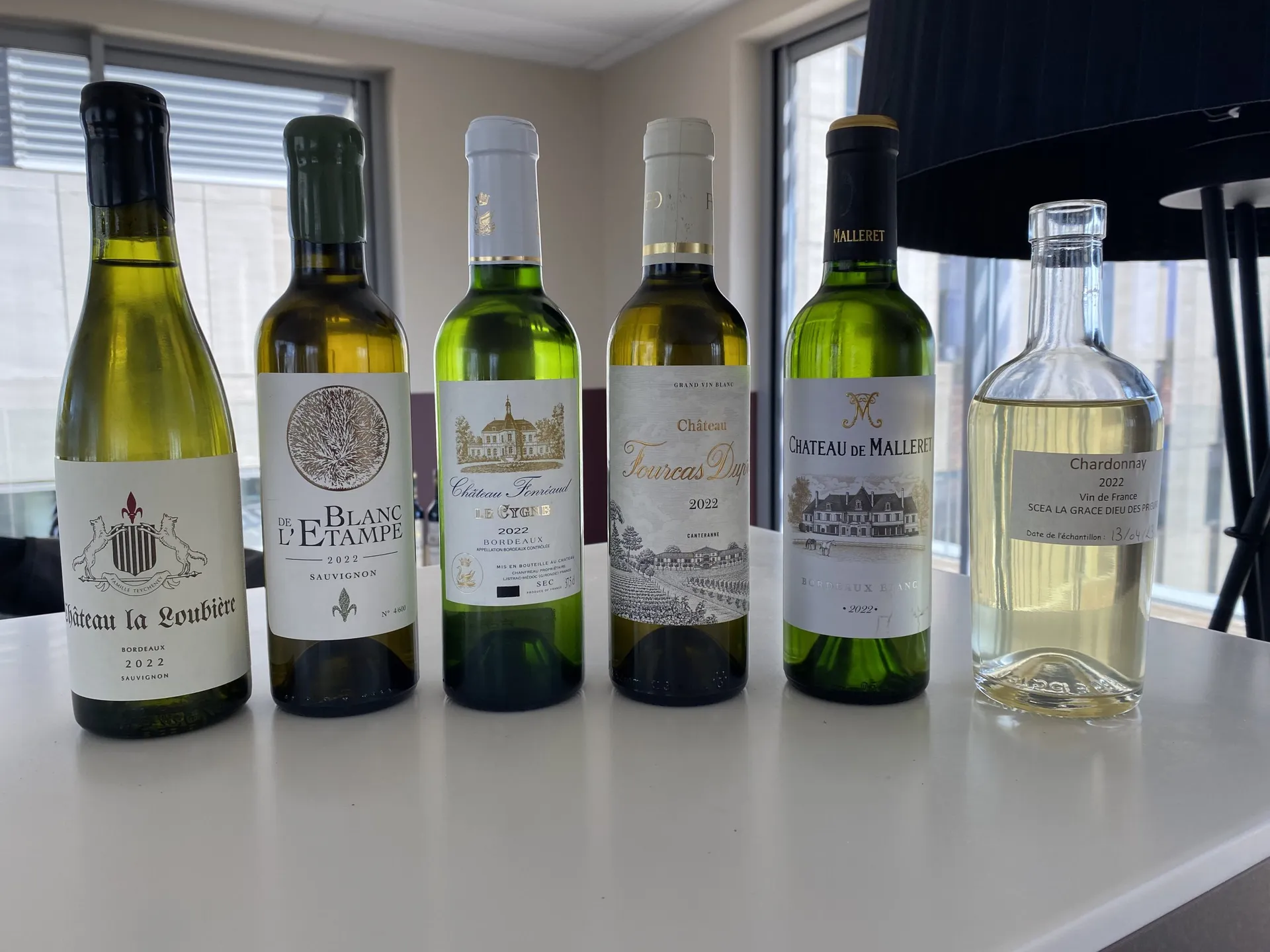
Where Pessac-Léognan truly separates itself from the rest of Bordeaux is in its dry white wines. In most Bordeaux appellations, white wine plays a supporting role. Here, it stands at the centre.
White Pessac-Léognan is typically a blend of Sauvignon Blanc and Sémillon, sometimes supported by Muscadelle. These wines are not driven by overt aromatics. Instead, they focus on texture, balance, and longevity.
Barrel fermentation and ageing are common, but handled with discipline. Oak adds structure and depth without erasing freshness. Over time, these wines develop notes of citrus peel, beeswax, smoke, and stone — evolving with a seriousness that surprises those unfamiliar with Bordeaux whites.
Estates such as Château Smith Haut Lafitte and Château Carbonnieux demonstrate how white Pessac-Léognan can age gracefully, often for decades.
Smoke as a Signature, Not a Style
Across both red and white wines, Pessac-Léognan often expresses a smoky, flinty character. This note is not uniform, but it is persistent enough to define the appellation’s identity.
In reds, it reinforces structure and seriousness. In whites, it adds depth and intellectual tension. This shared sensory thread is one reason the appellation feels coherent despite its stylistic range.
Pessac-Léognan wines do not aim to charm immediately. They ask for attention.
Why This Appellation Matters for Wine Travellers
For wine travellers, Pessac-Léognan offers something rare: breadth without confusion. Within a compact area, you can experience top-class red and white wines, classical and modern approaches, and estate philosophies that differ while remaining grounded in terroir.
This diversity is often most clearly understood during Bordeaux Wine Tours, where tasting across châteaux reveals how one appellation can speak in many voices without losing its accent.
Climate Change and Why Pessac-Léognan Is Better Positioned Than Most
As Bordeaux’s climate warms, Pessac-Léognan has emerged as one of the region’s most resilient appellations. The broader transformation of the region’s style is explored in detail in how climate change is changing the taste of Bordeaux wine, but here the combination of gravel soils, forest buffers, and careful vineyard management has allowed producers to adapt while preserving freshness and structural balance.
Gravel soils drain quickly after rain, reducing excess vigour, while underlying clay and limestone help vines withstand drought stress. Forested areas around the vineyards moderate extreme temperatures, creating mesoclimates that protect freshness even in warm vintages.
Cabernet Sauvignon continues to ripen fully without losing structure. White varieties retain acidity when harvested with precision. Rather than forcing stylistic change, climate pressure has sharpened decision-making.
Châteaux as Individual Voices of the Same Place
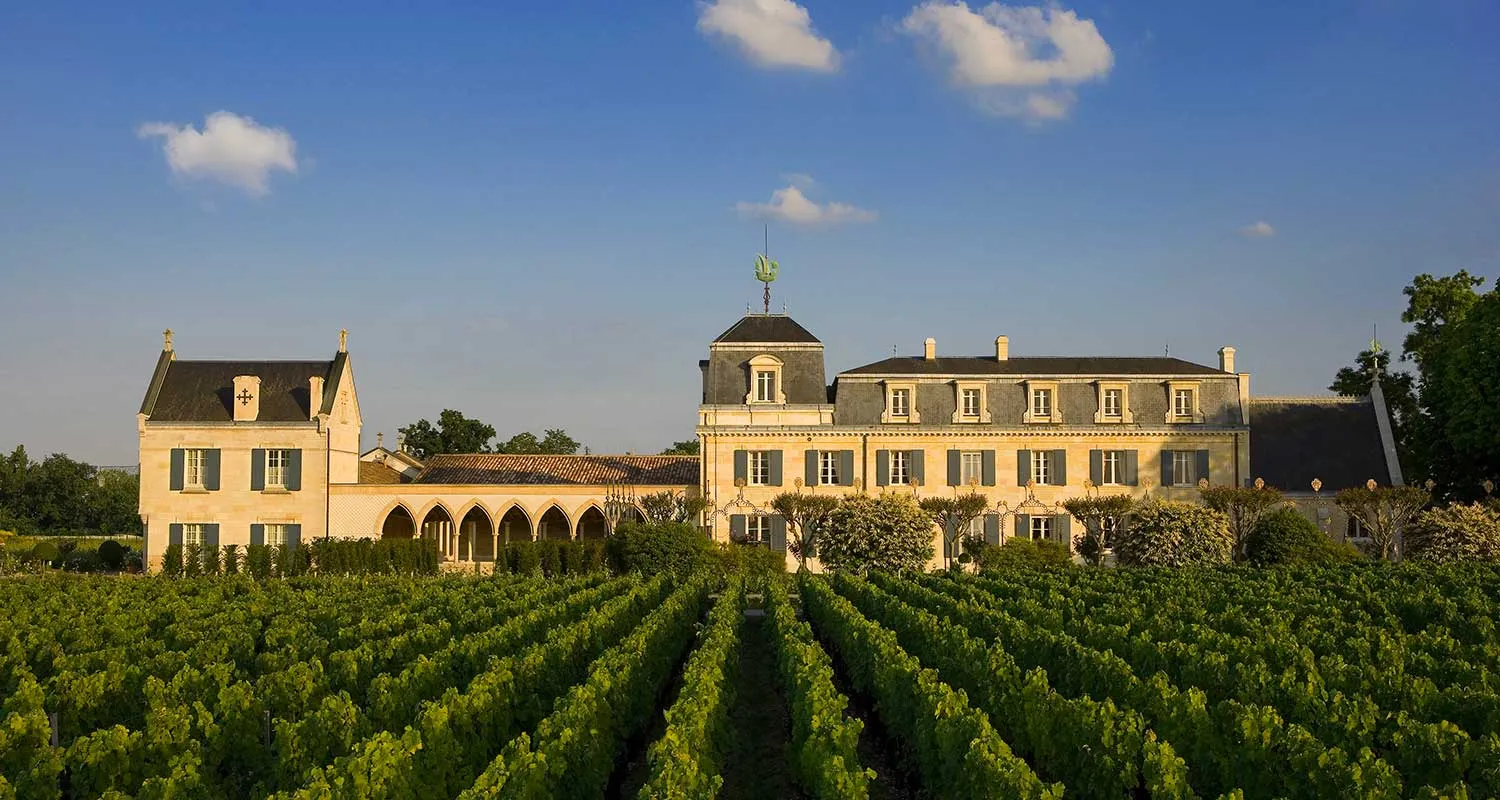
What makes Pessac-Léognan compelling is not uniformity, but intentional difference. Each château interprets the same geological language with its own accent.
Château Haut-Brion remains the historical anchor — a reference point for balance, longevity, and intellectual restraint. Its wines demonstrate how power can exist without heaviness.
Château La Mission Haut-Brion often presents a darker, more muscular expression, shaped by similar soils but a different philosophical hand.
Château Pape Clément reflects the appellation’s capacity for richness controlled by structure, while Château Smith Haut Lafitte illustrates modern precision across both red and white wines without abandoning classical form.
Château Carbonnieux, particularly for whites, shows how clarity and ageing potential can coexist without excess.
These estates do not compete stylistically. They converse.
Ageing Trajectories: Why Time Is So Kind Here
One of Pessac-Léognan’s defining strengths is how gracefully its wines age. Reds often evolve toward tobacco, graphite, and earthy nuance without losing line. Whites gain texture, savoury depth, and complexity rarely associated with Bordeaux.
This ageing capacity comes not from extraction or oak alone, but from balance at harvest. Acidity, tannin, and alcohol are aligned early, allowing time to refine rather than rescue the wine.
A Lens Through Which to Understand Bordeaux
Pessac-Léognan does not shout its importance. It reveals it gradually. By bridging red and white excellence, tradition and adaptation, urban proximity and rural discipline, it offers a complete picture of what Bordeaux can be at its most thoughtful.
For those seeking to move beyond labels and classifications, this appellation provides clarity.
Exploring it in depth — through estates, soils, and styles — is often one of the most rewarding experiences offered by Wine Tours in the Bordeaux region, where context transforms tasting into understanding.
Final Reflection: Versatility as a Strength, Not a Compromise
Pessac-Léognan’s greatest achievement is not excellence in one category, but coherence across many. It proves that versatility does not dilute identity — it sharpens it.
In a region often defined by hierarchy and tradition, Pessac-Léognan reminds us that Bordeaux’s future lies not in repeating the past, but in understanding it deeply enough to adapt without losing its soul.
