The Saint-Émilion Classification Explained: How Bordeaux’s Dynamic Hierarchy Really Works
Within the Bordeaux wine region, few systems generate as much fascination — and controversy — as the Saint-Émilion classification. Unlike the static 1855 hierarchy of the Médoc, Saint-Émilion’s ranking is dynamic, periodically revised, and structurally more complex. It is not merely a list of estates; it is a living framework that reflects performance, politics, terroir, and market perception.
To understand the Right Bank properly, one must first understand this classification. It shapes pricing, reputation, collector behaviour, and even stylistic ambition within Saint-Émilion itself.
For wine lovers seeking to experience the region beyond labels and rankings, grounding knowledge in place is essential. Beginning with a structured Saint Emilion Wine Tour provides critical context, allowing the classification system to be understood alongside terroir and real vineyard structure rather than as an abstract hierarchy.
Why Saint-Émilion Needed Its Own Classification
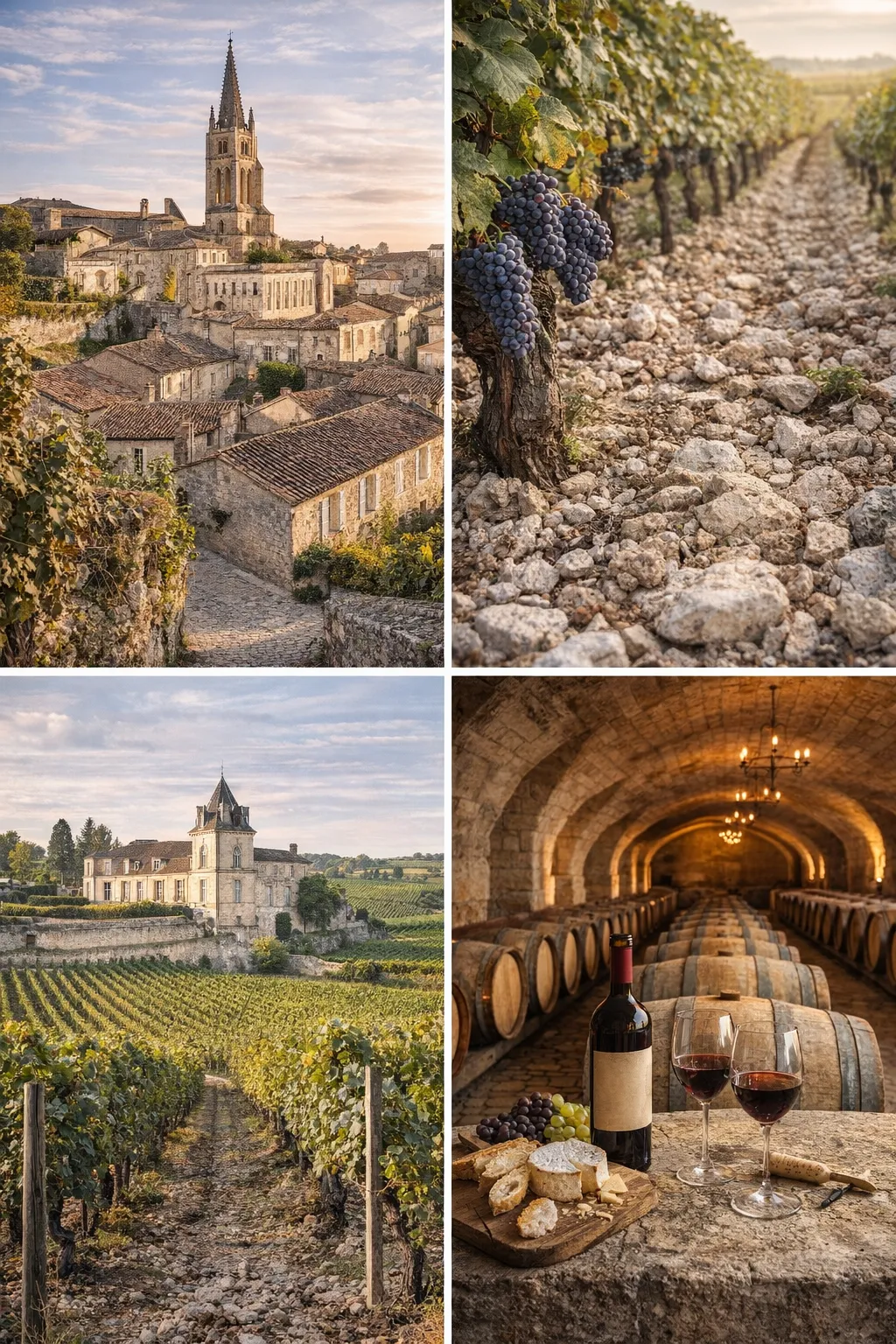
The 1855 Classification was created for the Paris Exposition and focused primarily on the Médoc and Sauternes. Saint-Émilion, situated on the Right Bank, was not included. For decades, this left the appellation without formal hierarchy.
By the mid-20th century, Saint-Émilion sought to establish its own ranking to:
- Recognise quality differentiation
- Strengthen international credibility
- Provide structure within the appellation
- Compete with Left Bank prestige
Thus, the Saint-Émilion classification was officially introduced in 1955.
Unlike 1855, however, this system was built to evolve.
The Structure of the Saint-Émilion Classification
The classification operates within three principal tiers:
Premier Grand Cru Classé A
The highest tier, representing estates considered exceptional within Saint-Émilion.
Premier Grand Cru Classé B
A slightly broader group of estates recognised for consistent excellence.
Grand Cru Classé
A larger group of classified estates meeting defined quality criteria.
Below these tiers exists the broader Saint-Émilion Grand Cru designation, which is separate from the classified ranking system.
Understanding this layered structure is essential. The classification is not simply about being “Grand Cru.” It is about where within that structure an estate sits.
The Defining Difference: Periodic Revision
The most distinctive feature of the Saint-Émilion classification is that it is revised approximately every decade.
This dynamic nature was intended to reward evolving quality and prevent stagnation. Estates may rise, fall, or withdraw from classification over time.
This stands in sharp contrast to the 1855 Classification, which has remained largely unchanged since its creation.
The advantages of a revisable system include:
- Recognition of improvement
- Encouragement of investment
- Responsiveness to modern standards
However, revision also introduces tension.
Evaluation Criteria: More Than Just Taste
Classification in Saint-Émilion is not based solely on blind tasting. Evaluation includes multiple dimensions:
- Vineyard management
- Winemaking facilities
- Historical consistency
- Market reputation
- Tasting assessments
This holistic approach reflects the complexity of modern wine evaluation. It attempts to balance terroir expression with operational quality.
Critics argue that such breadth can blur transparency. Supporters counter that wine quality cannot be reduced to a single tasting moment.
Why Controversy Is Built Into the System
Because the classification can change, it inevitably creates economic consequences.
Promotion to a higher tier often leads to:
- Increased global visibility
- Higher release pricing
- Greater collector interest
Conversely, demotion can significantly impact perception.
Legal challenges have accompanied several revision cycles. Estates contest methodology, evaluation transparency, and eligibility criteria.
This friction is not incidental — it is embedded in the structure of a reversible hierarchy.
The Economic Impact of Classification
Within the Bordeaux wine region, classification functions as economic signalling.
At the highest levels, classification can:
- Anchor en primeur pricing
- Strengthen auction performance
- Stabilise long-term brand value
However, market performance does not depend entirely on ranking. Some estates maintain strong demand independent of classification status.
This duality reveals that classification amplifies reputation but does not create it.
Terroir Versus Tier
One of the most important distinctions for serious wine lovers is separating terroir from tier.
An estate’s classification reflects evaluation criteria at a specific moment. Terroir, by contrast, remains constant.
The limestone plateau, clay slopes, and gravel pockets of Saint-Émilion create structural diversity across the appellation. Classification recognises excellence within that landscape, but it does not redefine soil.
Understanding this prevents overreliance on ranking alone when assessing quality.
How the Saint-Émilion System Shapes Style
Because classification can change, estates often invest heavily in:
- Vineyard precision
- Modernised cellars
- Improved blending strategy
The dynamic system incentivises ambition.
Some observers argue that this has elevated overall quality across Saint-Émilion. Others worry it encourages stylistic conformity aimed at satisfying evaluators.
The truth likely lies between these perspectives.
The Historical Evolution of the Saint-Émilion Classification
Since its official creation in 1955, the Saint-Émilion classification has undergone multiple revisions. Each revision reflects shifting priorities — from post-war rebuilding to modern global competitiveness.
Early revisions focused on stabilising quality benchmarks. Later updates introduced stricter evaluation frameworks, increased transparency requirements, and greater scrutiny of vineyard practices.
Over time, the classification evolved from a simple ranking into a multi-dimensional assessment system. It began incorporating not just tasting results, but vineyard management standards, technical investment, and long-term performance metrics.
This expansion reflects the modern understanding that fine wine quality is cumulative, not isolated.
Legal Challenges and Structural Tension
Because the classification is revisable, disputes are inevitable.
Promotions bring prestige and financial benefit. Demotions carry economic consequences. Estates affected negatively by revisions have, at times, pursued legal action challenging procedural fairness or evaluation criteria.
These disputes highlight the tension at the heart of the system:
- Should classification be flexible and merit-based?
- Or should it prioritise stability and long-term continuity?
The debate continues. Yet despite controversy, the classification endures — suggesting that the benefits of dynamism outweigh instability in the eyes of regional authorities.
Comparing Saint-Émilion to the 1855 Classification
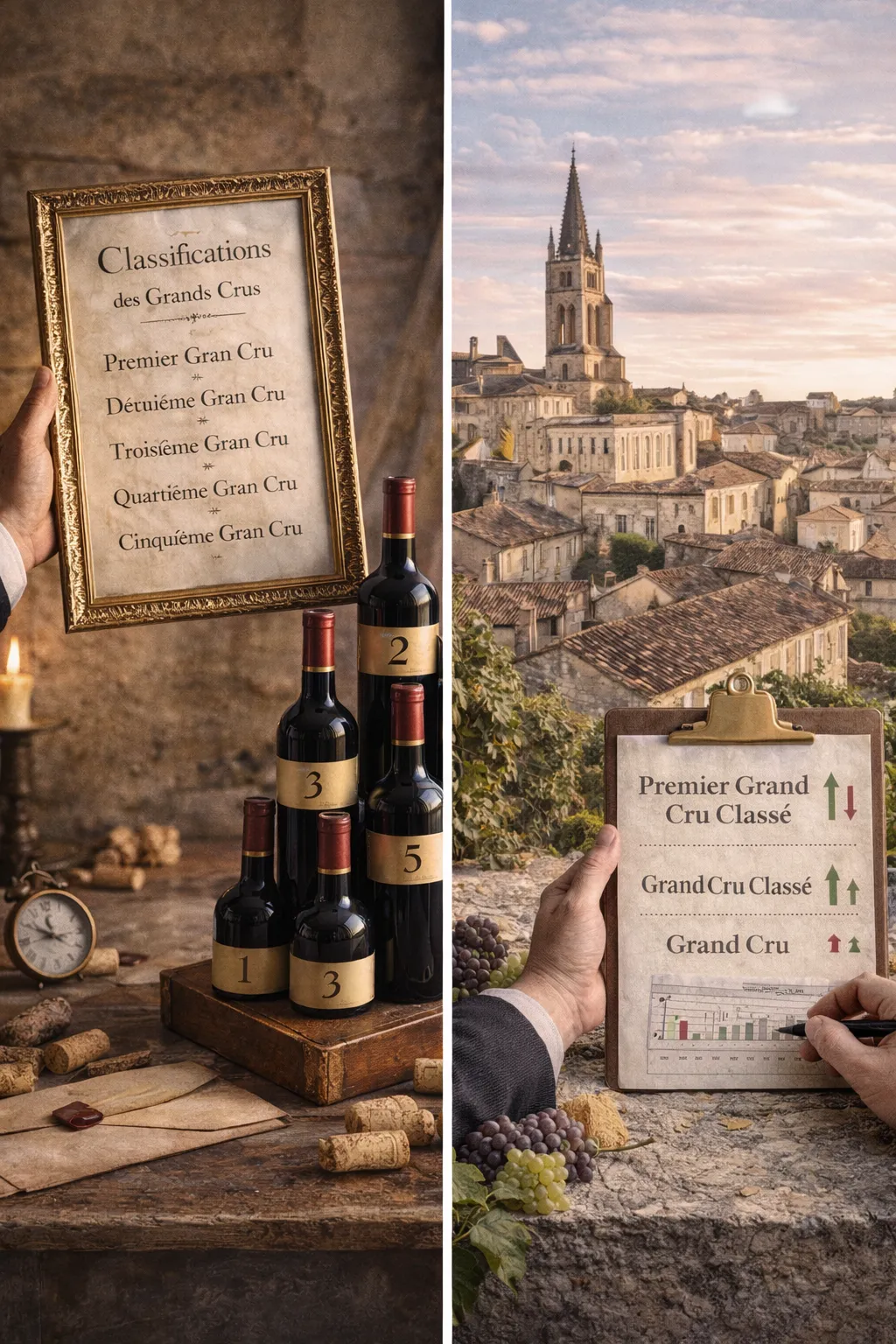
The contrast between Saint-Émilion and the 1855 Classification reveals two distinct philosophies within the Bordeaux wine region. The Left Bank hierarchy that produced estates known today as the Bordeaux First Growths follows a fixed historical structure, while Saint-Émilion’s system remains intentionally revisable.
1855 Classification
- Fixed hierarchy
- Based historically on pricing
- Minimal structural change
Saint-Émilion Classification
- Periodically revised
- Multi-factor evaluation
- Adaptive structure
The 1855 system offers predictability. Its permanence reinforces brand stability. Saint-Émilion’s model offers responsiveness, encouraging estates to improve continuously.
Both systems shape Bordeaux’s global identity, but in fundamentally different ways.
Collector Psychology and Classification
For collectors, classification simplifies complexity.
In a vast region like Bordeaux, hierarchy provides orientation. Buyers often rely on tier recognition when evaluating unfamiliar estates.
However, experienced collectors look beyond tier alone. They consider:
- Vintage quality
- Vineyard location
- Historical performance
- Bottle provenance
Classification functions as an entry filter, not a final verdict.
This distinction is essential. Tier indicates position within a system; terroir and bottle performance determine long-term satisfaction.
How the Classification Influences Investment Markets
Within global fine wine markets, classified Saint-Émilion estates often enjoy enhanced liquidity.
Auction houses and secondary markets reference classification status when establishing baseline estimates. Promotions can trigger immediate price increases. Demotions may prompt temporary corrections.
However, over time, sustained bottle performance stabilises pricing regardless of tier movement.
This reinforces a broader truth: classification amplifies value but cannot replace substance.
The Risk of Overemphasis
One risk of a dynamic classification is overemphasis on ranking rather than terroir.
Wine lovers can become fixated on hierarchy, overlooking estates whose wines perform consistently without occupying the highest tier.
Saint-Émilion’s diversity — from limestone plateau to clay slopes — means quality exists beyond strict classification boundaries.
Understanding this preserves perspective.
The Future of the Saint-Émilion Classification
Looking ahead, the classification faces several challenges:
- Maintaining transparency
- Balancing stability with adaptability
- Preserving credibility amid legal scrutiny
- Aligning evaluation criteria with evolving consumer expectations
Yet its survival across decades suggests resilience.
In a region defined by structure, Saint-Émilion’s willingness to adapt remains one of its defining characteristics.
A Closing Reflection
The Saint-Émilion classification is more than a ranking system. It is a reflection of Bordeaux’s internal debate between permanence and progress.
Unlike the fixed hierarchy of 1855, Saint-Émilion embraces revision. That flexibility invites controversy, yet it also encourages ambition. Estates must prove themselves not once, but repeatedly.
For wine lovers, understanding this system transforms perception. It reveals that hierarchy in the Bordeaux wine region is neither arbitrary nor static — it is negotiated over time, shaped by terroir, performance, and market confidence.
To fully appreciate Saint-Émilion beyond its tiers, grounding knowledge in experience is essential. Exploring the region through a structured Saint Emilion Wine Tour provides that clarity — connecting classification theory to the vineyards and soils that ultimately define the wines.
