The Underground Monolithic Church of Saint-Émilion Explained
In the centre of the medieval village of Saint-Émilion, beneath the stone streets and historic buildings, lies one of the most extraordinary monuments in the Bordeaux wine region. Hidden within the limestone hill on which the village stands is the vast Monolithic Church of Saint-Émilion, an underground sanctuary carved entirely from rock.
Unlike most churches in Europe, which were built upward using blocks of stone, this church was created by removing stone. Medieval builders excavated the interior space directly from the limestone bedrock, forming a monumental underground chamber supported by massive pillars carved from the same rock that surrounds it.
The result is one of the largest underground churches in Europe.
This remarkable monument reflects the deep connection between Saint-Émilion’s history and its geology. The same limestone that allowed medieval craftsmen to carve this subterranean church also forms the foundation of the vineyards that produce some of the most celebrated wines on the Right Bank of Bordeaux.
Travellers exploring the historic village often encounter this underground church while discovering the region during a Saint Emilion Wine Tour, where the relationship between wine, landscape, and history becomes immediately clear.
Understanding the Monolithic Church therefore means understanding the unique landscape of Saint-Émilion itself.
Where the Monolithic Church Is Located
The Monolithic Church lies directly beneath the centre of Saint-Émilion’s medieval village.
From the outside, the site appears relatively modest. Only the bell tower rises above the rooftops of the surrounding buildings. Yet beneath the surface, a vast underground sanctuary extends deep into the limestone hill.
Visitors entering the site descend below street level into the immense chamber known as Église Monolithe de Saint-Émilion, one of the most unusual religious monuments in France.
Inside, the space opens into a monumental hall with high ceilings, carved columns, and galleries cut into the surrounding rock.
The scale of the excavation becomes immediately apparent once visitors step into the main chamber.
What “Monolithic” Means
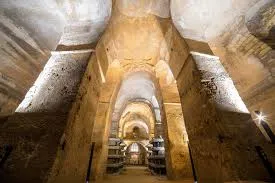
The word monolithic describes something carved from a single block of stone.
Most medieval churches were constructed using stone blocks quarried elsewhere and assembled to create walls, arches, and towers. The Monolithic Church of Saint-Émilion was created in the opposite way.
Instead of building upward, workers excavated downward into the limestone hill.
Using simple tools such as chisels and hammers, they gradually removed thousands of tonnes of rock to create a vast interior space.
The final structure measures roughly thirty-eight metres long and more than eleven metres high.
Because the entire church was carved from the same rock mass, its columns and walls are not separate structural elements. They are part of the original stone itself, sculpted into shape during excavation.
Limestone Beneath Saint-Émilion
The existence of this underground church is directly linked to the geology of Saint-Émilion.
The village stands on a limestone plateau that has been quarried for centuries. This limestone was widely used as a building material throughout Bordeaux and the surrounding region.
As stone was extracted beneath the village during the Middle Ages, large underground cavities formed.
Over time, some of these spaces were transformed into religious sites, storage chambers, and passageways. The Monolithic Church became the most ambitious of these underground constructions.
The same limestone that allowed the church to be carved also shapes the wines produced in the surrounding vineyards.
For readers interested in how soil and geology influence wine style across Bordeaux, the subject is explored in Gravel vs Clay vs Limestone: How Bordeaux Soils Shape Wine Styles, which explains why limestone soils are central to many Right Bank wines.
The Story of Saint-Émilion
The village itself takes its name from a monk named Émilion, who lived in the region during the eighth century.
According to historical tradition, Émilion was a travelling monk seeking solitude and spiritual devotion. He eventually settled in a small cave carved into the limestone hills overlooking the Dordogne valley.
His life as a hermit attracted followers and pilgrims.
Over time, a religious community formed around the cave where he lived. This community gradually developed into the medieval town that now bears his name.
The history of the monk and his influence on the region are explored in greater detail in Who Was Saint Émilion? The Man Behind Bordeaux’s Most Famous Wine Name, which explains how his legacy shaped both the village and the surrounding vineyards.
How the Underground Church Was Carved
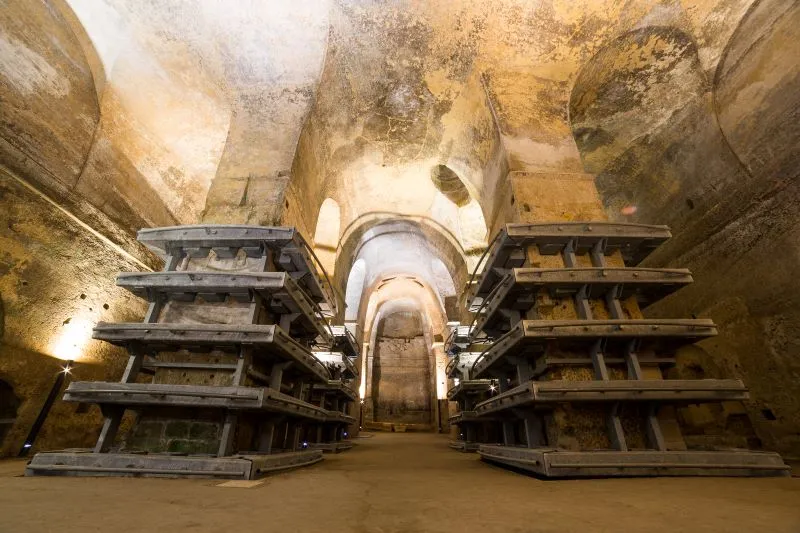
The Monolithic Church likely began to take shape during the twelfth century.
Medieval builders began excavating directly into the limestone hillside beneath the village. The work was slow and labour-intensive, requiring skilled craftsmen to carve the rock without weakening the structure above.
The excavation created a massive underground hall supported by pillars carved directly from the surrounding rock.
Above the main chamber, galleries and passageways were also carved, allowing light and sound to circulate through the subterranean space.
Because the structure was carved rather than assembled, the church feels less like a constructed building and more like a vast stone cavern shaped by human hands.
Religious Life in Medieval Saint-Émilion
During the Middle Ages, Saint-Émilion became an important destination for pilgrims travelling across southwestern France.
Pilgrims heading toward Santiago de Compostela often passed through the region, bringing religious activity and cultural exchange to the village.
The Monolithic Church served as a central place of worship during this period.
Candlelit ceremonies held within the vast underground chamber must have created a dramatic atmosphere, with light reflecting off the carved limestone surfaces.
Over time, additional religious spaces were carved within nearby underground cavities, forming a network of subterranean chapels and chambers beneath the village.
These spaces reveal how important religion was to the development of Saint-Émilion during the medieval era.
The Church and the Landscape of Saint-Émilion
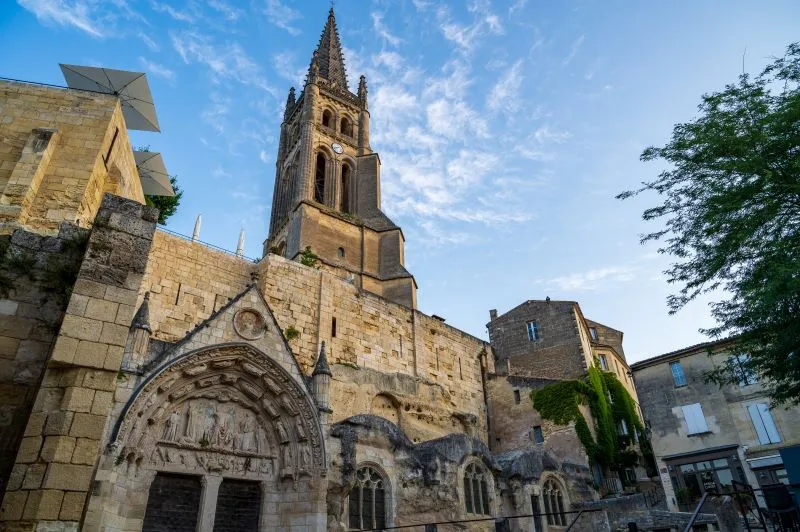
Standing inside the Monolithic Church offers a striking perspective on the landscape above.
Above ground, vineyards stretch across the limestone plateau that surrounds the village. Below ground, the carved sanctuary reveals the same rock that supports those vineyards.
This connection between geology and culture is one of the defining characteristics of Saint-Émilion.
The land that produces wine also shaped the architecture of the village.
Travellers often gain a deeper appreciation of this relationship while exploring the area during a Saint Emilion Wine Tour, where the vineyards, medieval streets, and underground monuments together tell the story of the region.
Visiting the Monolithic Church Today
Today the Monolithic Church remains one of the most remarkable historical landmarks in the Bordeaux wine region.
Visitors can descend beneath the village streets to explore the underground chambers and witness the scale of the excavation firsthand.
The experience offers a rare opportunity to stand within a monumental structure carved entirely from stone.
Above ground, the village of Saint-Émilion continues to thrive as one of the most important wine destinations in France.
Below ground, the Monolithic Church preserves a reminder of the village’s medieval origins and the deep connection between its history and the limestone landscape.
Together, the vineyards, the village, and the underground church reveal why Saint-Émilion remains one of the most fascinating places in the world of wine.
The Architecture of the Underground Church
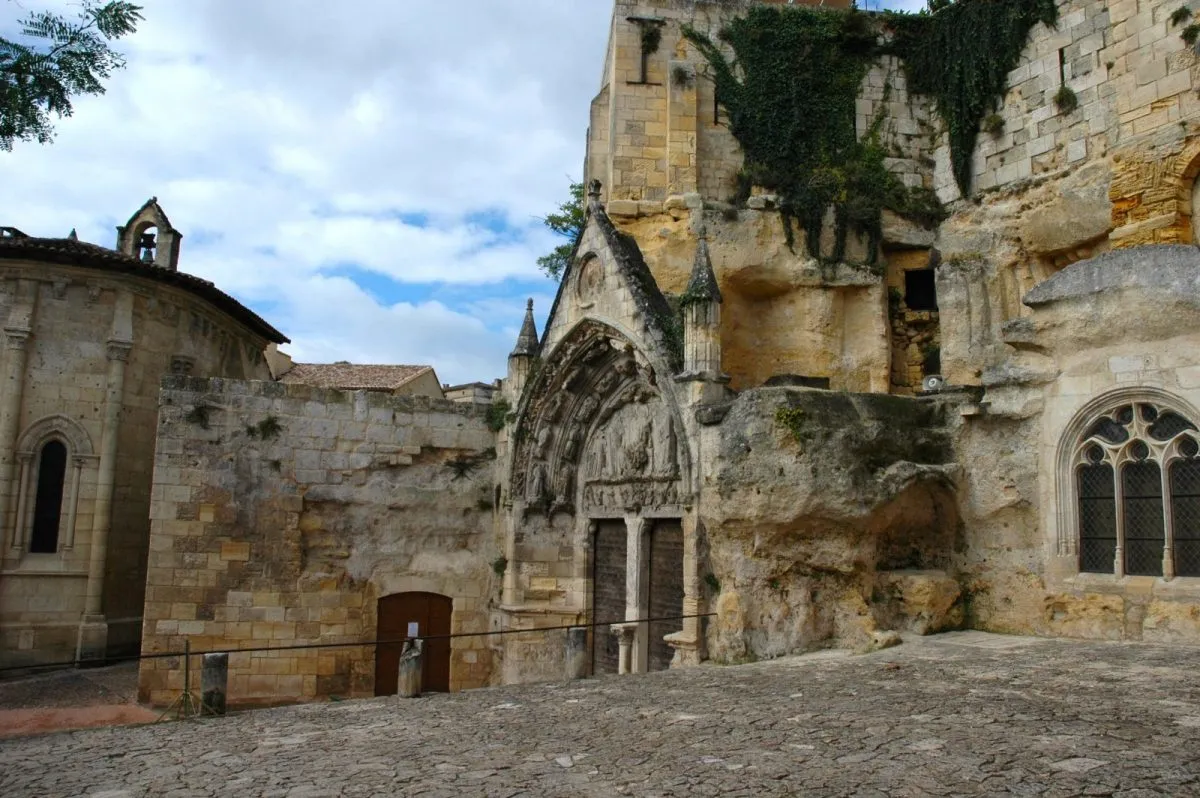
Standing inside the Monolithic Church reveals how extraordinary the structure truly is. Unlike traditional churches where walls, columns, and vaults are assembled from separate stones, every element here was carved directly from the limestone hillside.
The central chamber stretches beneath the village like a vast stone hall. Massive pillars rise from the rock floor to support the ceiling, not because they were built there but because they were intentionally left in place during excavation to preserve structural stability.
The ceiling itself forms a large vaulted space, giving the church the proportions of a cathedral even though it lies entirely underground.
Carved galleries overlook the main chamber, creating multiple levels within the subterranean structure. These galleries allowed clergy and visitors to observe religious ceremonies from above while maintaining the open character of the space below.
The effect is striking. The architecture feels simultaneously monumental and organic, as though the church emerged naturally from the rock rather than being constructed by human hands.
Underground Passages and Subterranean Spaces
The Monolithic Church is not an isolated chamber. Beneath the village of Saint-Émilion lies an entire network of underground tunnels, chambers, and galleries carved into the limestone plateau.
These underground spaces developed over centuries as stone was quarried for construction throughout the region.
Many of these excavations later gained new uses. Some became storage cellars for wine, while others served religious or defensive purposes.
The Monolithic Church stands as the largest and most ambitious example of how these underground cavities were transformed into architectural spaces.
Walking through the underground corridors surrounding the church offers visitors a glimpse into a hidden world beneath the village — a world where geology, architecture, and history intersect.
The Bell Tower Above the Church
While most of the church lies underground, one striking feature rises above the rooftops of Saint-Émilion.
The bell tower visible above the village marks the location of the subterranean church below. From a distance, the tower appears similar to those found in many medieval towns across France.
Yet this tower serves a very unusual building.
Beneath it lies not a typical church nave but a vast underground sanctuary carved entirely from rock.
This contrast between the modest tower above ground and the enormous structure below is part of what makes the Monolithic Church so remarkable.
Medieval Craftsmanship and Engineering
Carving such a massive structure from limestone required extraordinary craftsmanship.
Medieval builders worked with simple tools — chisels, hammers, and picks — yet managed to create a chamber large enough to host large religious gatherings.
The stability of the church demonstrates a deep understanding of the rock’s structural properties.
Rather than removing all the stone, workers left carefully positioned pillars to support the ceiling. These pillars distribute weight across the surrounding rock and prevent collapse.
The result is a structure that has remained stable for centuries.
This achievement reflects the remarkable skill of the medieval craftsmen who shaped the church and the limestone landscape of Saint-Émilion.
Pilgrims, Faith, and Medieval Life
During the Middle Ages, Saint-Émilion became an important destination for pilgrims travelling across southwestern France.
Pilgrims journeying toward Santiago de Compostela often passed through the region, bringing religious and cultural activity to the village.
The underground church provided a dramatic setting for worship and prayer.
Candles illuminated the vast stone interior, casting flickering light across the carved pillars and vaulted ceilings.
These ceremonies must have created a powerful atmosphere within the subterranean sanctuary.
Over time, the religious importance of Saint-Émilion helped establish the town as a spiritual as well as agricultural centre in the region.
The Connection Between the Church and the Vineyards
One of the most fascinating aspects of the Monolithic Church is its connection to the surrounding vineyards.
The same limestone plateau that allowed the church to be carved also forms the geological foundation of the Saint-Émilion wine region.
Limestone soils play a crucial role in shaping the wines produced here. The rock stores moisture and regulates vine growth, contributing freshness and structure to Merlot-dominant blends.
Above the church, vineyards stretch across the plateau that defines the landscape of Saint-Émilion.
Below the vineyards lies the carved sanctuary of the Monolithic Church — a reminder that the village’s cultural and agricultural history are both rooted in the same geological foundation.
Visitors often gain a deeper appreciation of this relationship while exploring the region during a Saint Emilion Wine Tour, where vineyards and historical landmarks reveal the story of the land.
Saint-Émilion as a UNESCO World Heritage Site
In recognition of its unique historical and cultural importance, the Saint-Émilion landscape was designated a UNESCO World Heritage Site in 1999.
This designation reflects not only the village’s medieval architecture but also the surrounding vineyards that have been cultivated for centuries.
The Monolithic Church plays a central role in this recognition.
Its underground architecture represents a rare example of how natural geology and human craftsmanship combined to create a monumental religious structure.
Together with the vineyards and historic village streets, the church forms part of a landscape where agriculture, history, and architecture remain closely connected.
Why the Monolithic Church Remains Extraordinary
Few places illustrate the relationship between geology and culture as clearly as the Monolithic Church of Saint-Émilion.
The limestone that shapes the wines of the region also allowed medieval builders to carve one of Europe’s most unusual churches.
Above ground, vineyards stretch across the plateau and medieval streets wind through the village.
Below ground, the carved sanctuary of the Monolithic Church reveals a hidden world beneath the stone.
For visitors and wine lovers alike, the site offers more than an architectural curiosity. It provides a glimpse into the deeper history of Saint-Émilion — a history where faith, landscape, and winemaking have been intertwined for centuries.
Exploring this remarkable monument often becomes one of the most memorable moments during a Saint Emilion Wine Tour, where the village’s underground past meets the vineyards that continue to shape its present.
